Fundación para el Futuro de la Salud will fund the stipend of a resident in the Neurosurgery Program at the Recinto de Ciencias Médicas—an approach designed to expand specialist training that could be replicated in other fields of medicine
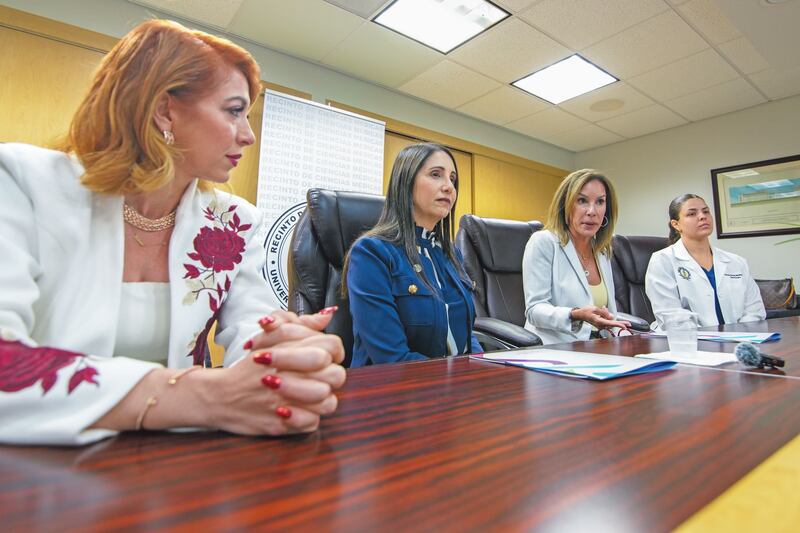
Only 17 to 20 neurosurgeons are currently practicing in Puerto Rico—approximately one specialist for every 200,000 residents. In response to this reality, the Recinto de Ciencias Médicas (RCM) of the Universidad de Puerto Rico (UPR) has taken a step toward strengthening the training of new specialists through a partnership with Fundación para el Futuro de la Salud, which will fund the stipend of one of the residents in its Neurosurgery Program.
The agreement supports the expansion of a program that resumed operations in 2025 after losing its accreditation from the Accreditation Council for Graduate Medical Education in 2021, which led to its closure in 2022. The hope is that this model can be replicated across residency programs in other medical specialties.
The Neurosurgery Program currently has two residents, and the new contribution will help sustain its growth. Fundación para el Futuro de la Salud will invest $319,000 to cover Dr. Adriana Vázquez Medina’s stipend throughout the six years of her residency. Dr. Vázquez Medina, the program’s first resident, is currently in her second year of training. Dr. Esteban Rivera Rivera later became the program’s second resident.
For Edna Marín, president of Fundación para el Futuro de la Salud, the responsibility of training new specialists should not rest solely with the government.
“This is a call to action. We are calling on the private and nonprofit sectors to become involved. We must determine how our organizations can also begin supporting the healthcare system. Otherwise, we will not move in the direction we need to go,” she said.
The Departamento de Salud remains the primary funder of residency positions at RCM, subsidizing 27 positions in 2025 alone. Its resources are limited, however, prompting the institution to incorporate philanthropic support to expand its training capacity.
Through this collaborative agreement, Fundación para el Futuro de la Salud will fund the stipend for one position in the Neurosurgery Residency Program of the Escuela de Medicina at RCM-UPR until Dr. Vázquez Medina completes her training in 2032.
Débora Silva Díaz, dean of the Escuela de Medicina at RCM, emphasized that the Recinto de Ciencias Médicas graduates more medical residents than any other institution in Puerto Rico. In June, the institution awarded degrees to 134 specialists and subspecialists, 75% of whom will remain on the island to practice medicine.
“This model represents an extraordinary contribution. If other foundations follow the innovative approach established by Fundación para el Futuro de la Salud, we can begin discussing how to expand residency programs and increase the number of residents in our existing programs, alongside all those who are already our partners,” Silva Díaz explained.
Training new neurosurgeons is particularly important because of the role Centro Médico de Río Piedras plays as Puerto Rico’s principal trauma center and tertiary care hospital. It treats some of the island’s most complex neurological cases, ranging from head trauma and spinal cord injuries to brain tumors and strokes
If she successfully completes her training, Vázquez Medina will become the first neurosurgeon to graduate under this funding model in 2032.
“I am grateful that efforts are being made to continue funding residency positions and create opportunities for additional residents. You do not realize how urgently additional personnel are needed until you are working at Centro Médico,” she said.
The resident acknowledged that the financial support provides significant relief in a specialty that requires years of preparation and a substantial personal and family commitment.
“I feel happy and honored to have this opportunity. It involves not only considerable mental sacrifice, but also a significant financial sacrifice. I am deeply grateful that all my efforts—as well as those of my family and everyone who has supported me—have brought me to this point. I am now in my second year and operating directly alongside neurosurgeons, so I am seeing the sacrifices of all those years begin to bear fruit,” she said.
Arelis Febles Negrón, associate dean of the Escuela de Medicina at RCM, said that partnerships of this kind create new opportunities to strengthen graduate medical education and expand the availability of residency programs.
“This funding model, which is an important part of the structure we must provide, gives us additional tools and greater opportunities to continue growing.”
She also emphasized that collaboration between academia and other sectors could serve as a model for the continued development of medical specialty programs in Puerto Rico.
“Adriana is one of the residents represented by this initiative, but what makes us especially pleased is that other sectors are collaborating with graduate medical education. This partnership is inspiring because it demonstrates that there is a new model we can continue expanding. We have many projects we want to launch and develop. With funding and partnerships like these, we do not feel alone—we feel supported and recognize that this is truly a project for Puerto Rico.”
To read the original version of this article, click here.


